This past week, I got a text from a mom that reads like texts I get from moms EVERY week. Her daughter (straight A student, AP and Honors classes, involved, hardworking, etc, etc…) had just gotten her first ACT score back.
It was a 21.
I don’t understand. She works so hard. Her grades are perfect. This score is not what she should be getting on this test.
If I had a dollar for every time I got a text like this, I’d be booking myself a flight to someplace tropical right now and not writing a newsletter! I’ve gotten some version of this text hundreds of times. Every single time, my answer is the same.
The score isn’t wrong. Neither is the GPA. They’re just measuring completely different things. I realize this is not immediately comforting. 😉 Bear with me.
Here’s what’s actually going on.
Your student’s GPA measures effort, consistency, and the ability to meet expectations over time. It rewards showing up, completing work, studying for tests in subjects they’ve been taught by an actual human who wanted them to succeed. The GPA also reflects targeted effort in a specific time frame. That human teacher talked about, maybe, circles in class, gave your student circles to practice for homework, helped them practice circles in class, and then gave them a test specifically on what they taught them about circles.
That 3.9 or 4.2 or whatever good GPA means your student is good at school, and that is genuinely worth celebrating!
The ACT and SAT measure something else entirely.

First of all, they will indeed press to see what your student knows about those circles, but also… triangles and pyramids and prealgebra, Algebra I, Algebra II, geometry, a little bit of pre-calculus, statistics, and number theory. On top of that, they have to do a reading section and evaluate sentences on their grammar and punctuation, which they may or may not have ever learned in school. All at once, with no study guide, and a running clock.
The ACT and SAT measure speed and pattern recognition under pressure. They test your student’s ability to work through unfamiliar problems under timed conditions. This requires a specific and unique form of strategic thinking: knowing when to skip a question and how many, when to guess, how to manage time across multiple sections without completely unraveling somewhere in the middle.
Here’s the part that gets me every time: they don’t teach this in school. Not really. School tests are subject-specific, related to material that was specifically presented in class and often reviewed before a test. Some schools even offer students a chance to go back and fix their errors on a test before they get a final grade. We’re all aware that’s not how the SAT or ACT works.
Instead, we get them rounded up on a Saturday morning, hand them a single three(ish)-hour standardized test that covers a little bit of all the material they have covered since probably seventh grade; written in unique, standardized test language that doesn’t look like the tests their teachers wrote; impress upon them the importance of this test (even though they don’t really know what’s on it) because it will help determine what colleges they get into and how much scholarship money they get; wish them luck; and then act surprised when their score doesn’t look as good as their GPA.
It’s not a fair fight. It never was. The testing companies are grateful for your confusion.
That's what I'm here for: teaching kids the unwritten rules of the game, every single day. :)

What this means for your family.
If your student has strong grades and a score that doesn’t reflect their ability, I want you to listen to me: that gap is not a character flaw, and it is not a ceiling.
It is a skills gap, and skills gaps are closeable.
Here’s what actually moves scores. (And no, the answer is not “just study harder,” which is the academic equivalent of telling someone to “just relax” on a roller coaster. I will actually go so far as to say that studying is not something students should do for these tests at all!)
Learning the format. The ACT and SAT are not general knowledge tests. They’re highly specific instruments with very predictable patterns. Students who know those patterns before they sit down have a massive advantage over students who don’t. This is learnable. It is also, honestly, pretty gameable once you know the rules.
Identifying the actual weak spots. Most students assume they’re just “bad at math” or “bad at reading.” Every time a mom tells me that “her kid is just bad at reading comprehension”, I tell her that’s fine, because you don’t really need reading comprehension to get a better score. True story. Usually the problem is more specific: a particular question type, a pacing issue, a knowledge gap. I know I’m venturing into self-interest here, but this is why tutors are so helpful. Someone who knows the tests inside and out can help a student find the actual problem/issue/gap. Then we fix that. Practice that. Leave the general self-criticism for another day.
Repetition with feedback. Khan Academy is free and genuinely good for students who are self-directed enough to use it consistently and honest/insightful/self-aware enough to identify their own errors and weaknesses. In my 30+ years of working with high school students, I will tell you with great love that the number of kids who are capable and self-knowledgeable enough to do this on their own is a single-digit percentage of kids. For everyone else, which is most teenagers on the planet, a good tutor changes everything.
Practicing under real conditions. Timed, full-length practice tests in a quiet room with no phone. Not a few questions on an app between Instagram scrolls. The stamina required to perform across four sections is its own skill, and it only develops one way.

Lots of work went into this final score!
The timeline question.
I’m going to be straight with you, and I’m sorry this may induce some anxiety.
If your student is just finishing junior year, I won’t sugarcoat it: the clock is loud. You’re looking at a summer to prep and a handful of fall test dates before college applications are due. That is workable! Students make meaningful score gains over a focused summer all the time. But “We’ll figure it out in August” is not a plan. August is the plan. Start now.
If your student is just finishing sophomore year, you are sitting in the sweet spot and most of you don’t even know it. My strong recommendation: take the ACT or SAT in June before summer starts. Not because you’re ready to crush it (you’re not, and that’s fine), but because a real baseline score is worth more than any amount of guessing about where you stand. You’ll spend junior year doing the bulk of your testing, and knowing your starting point changes everything about how you prepare. I kid you not. Start now.
If your student is just finishing their freshman year, bookmark this newsletter and go enjoy your summer. You’ve got time. Come back in the fall and we’ll talk. 😊
And if you’re the parent of a graduating senior reading this? Congratulations. You made it. This section is not for you. Go celebrate.
Back to that gap.
I have a current student who went from an 18 in December to a 25 in April.
Another? A 22 in December to a 28 in April.
Those kinds of score improvements literally change the trajectory of your college education!
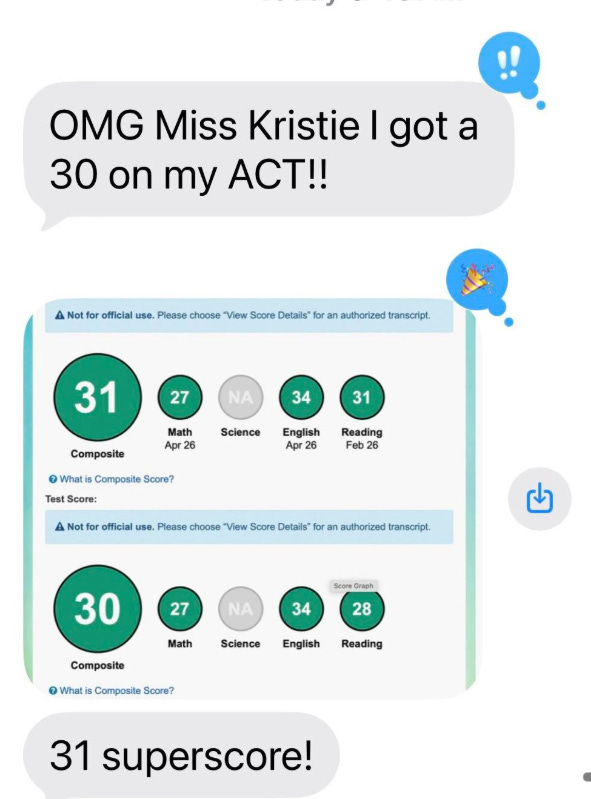
Love these texts!!!
The GPA took years to build and hopefully is already strong. The scores? We can catch those up, but time slips by. You’ve got to give your student some time to make that improvement, so it catches up to that GPA.
Anyhow. That’s what this newsletter is for. Making sure you have the information you need, when you need it, so your student gets a fair shot.